TONGUE DEPRESSORS / LOGIC
Our minds make trees to understand reality.

There are two major types of language disability, called Broca’s aphasia and Wernicke’s aphasia. They result from damage to Broca’s and Wernicke’s areas in the brain, usually as a result of a stroke.
Wernicke’s aphasia is fairly easy to understand. What breaks down in patients with this condition is the ability to connect language elements (words, phrases, sentences) to their meaning. This affects both speech (you can’t find the word for what you are trying to say) and comprehension (you can’t figure out what the words mean). Watch, for example, this patient, who evidently is describing his difficulty in speaking:
“When they come out, they quit” — this seems to refer to his own “terrible words”. Note that the words affected are the ones that carry most meaning — nouns, verbs — whereas filler words and conjugations are used correctly and fluently.
Note also what happens when the interviewer asks the question, “Where do you live, doc?” Instead of turning the question towards himself (“Where do I live?”), the patient repeats the question in second-person (“Where do you live?”), indicating that he had not been able to process its meaning.
Broca’s aphasia is more puzzling. At first glance you would be excused in thinking Broca’s patients have purely mechanical defects that affect their speech but not understanding. They seem to have a solid grasp of what is being said to them, and easily use body language to explain themselves. However, they are unable to generate proper speech. In some forms of the condition, patients are stuck on a syllable or two:
Make sure you watch until 1:49 — it’s an amazing moment — and note that this patient can generate some simple multisyllabic words (like “eleven”).
In other forms of Broca’s aphasia, patients can say complete words, but cannot produce proper sentences. This person, for example, uses the correct words to tell a story, but he uses them in a way a foreigner with a dictionary would: no good, ache, knees, ankles, home, doctor, legs, walking, no good. You get what he is trying to say, but it’s a list, not a sentence.
The thing is, language is not just a list of words. Consider the phrase “garlic butter bacon cheeseburger”. If you read it to someone in the Middle Ages, they would interpret it as five separate words. But a modern English speaker would instantly understand that “cheese” and “burger” form a unit, as do “garlic” and “butter”, that bacon modifies the cheeseburger, and garlic butter additionally modifies the result. This is what the phrase looks like to our brain:
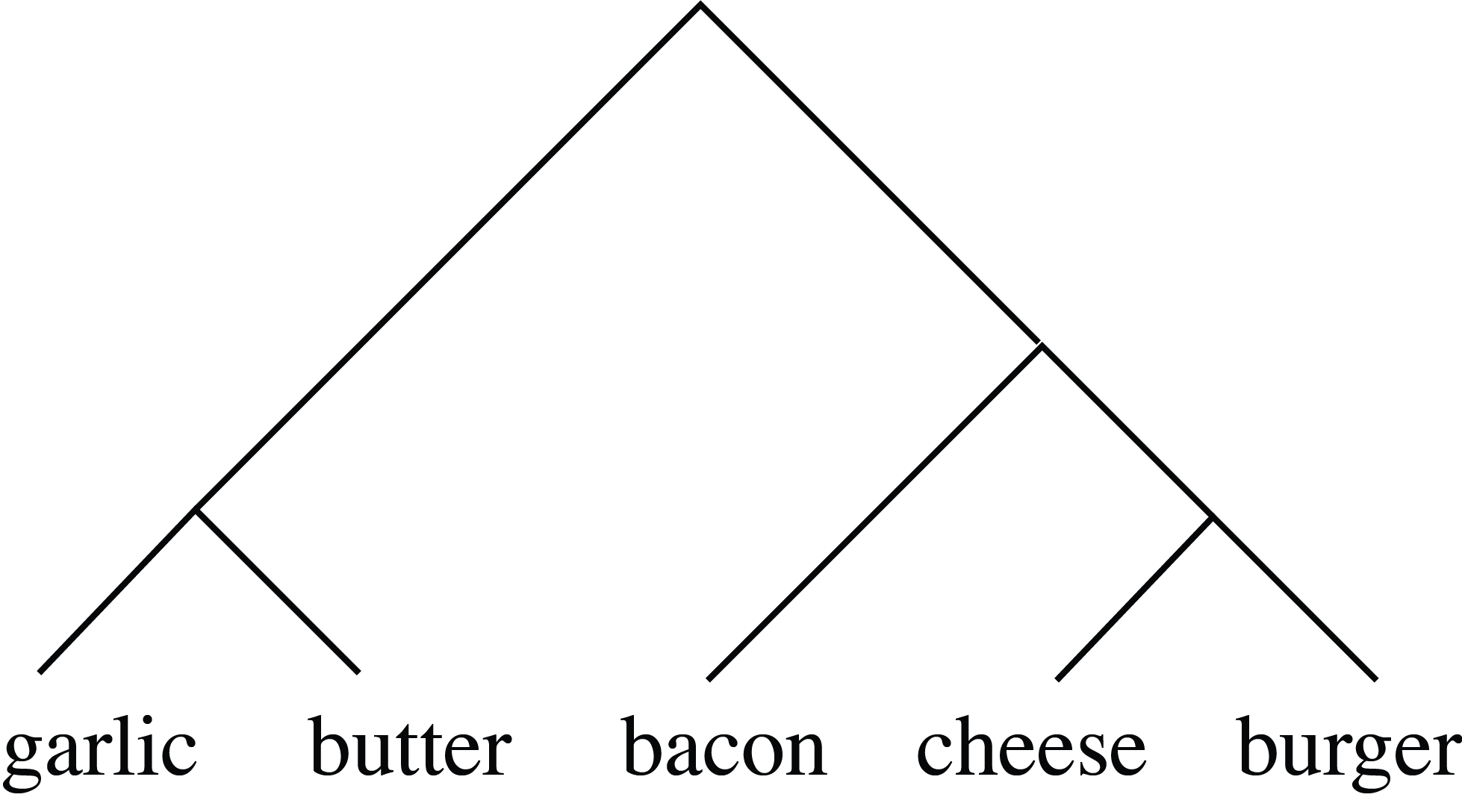
Seeing this tree behind the words is a what speaking a language really means. What is especially striking is that damage to Broca’s area not only makes it difficult for people to build language structures such as the one above, but also to understand them. For instance, in this video a patient easily answers questions with complicated vocabulary (“Do submarines usually fly? What about a zeppelin?”) but is completely stumped by a question that requires the understanding of grammatical structure: “The leopard was killed by the lion. Which animal died?”).
A typical patient with Broca’s aphasia would be able to understand the following sentence:
The apple the girl ate was green.
But they would be unable to understand another, very similar one:
The boy the girl chased was tall.
The difference is that the meaning of the first sentence can be inferred from the meanings of words alone, because there’s no ambiguity — apples don’t eat girls, and girls are not usually green. In the second sentence, structure is key: both the girl and the boy could be tall and could be chasing each other, so you have to process how the sentence is organized to figure out what refers to whom. Broca’s aphasiacs have a hard time doing that.
But the most interesting thing about Broca’s aphasia is that it affects more than language. In a study published in 1980, researchers showed patients with different forms of brain damage a pattern of sticks (they used tongue depressors) and then asked to reproduce it. Here are the patterns they asked people to reproduce:
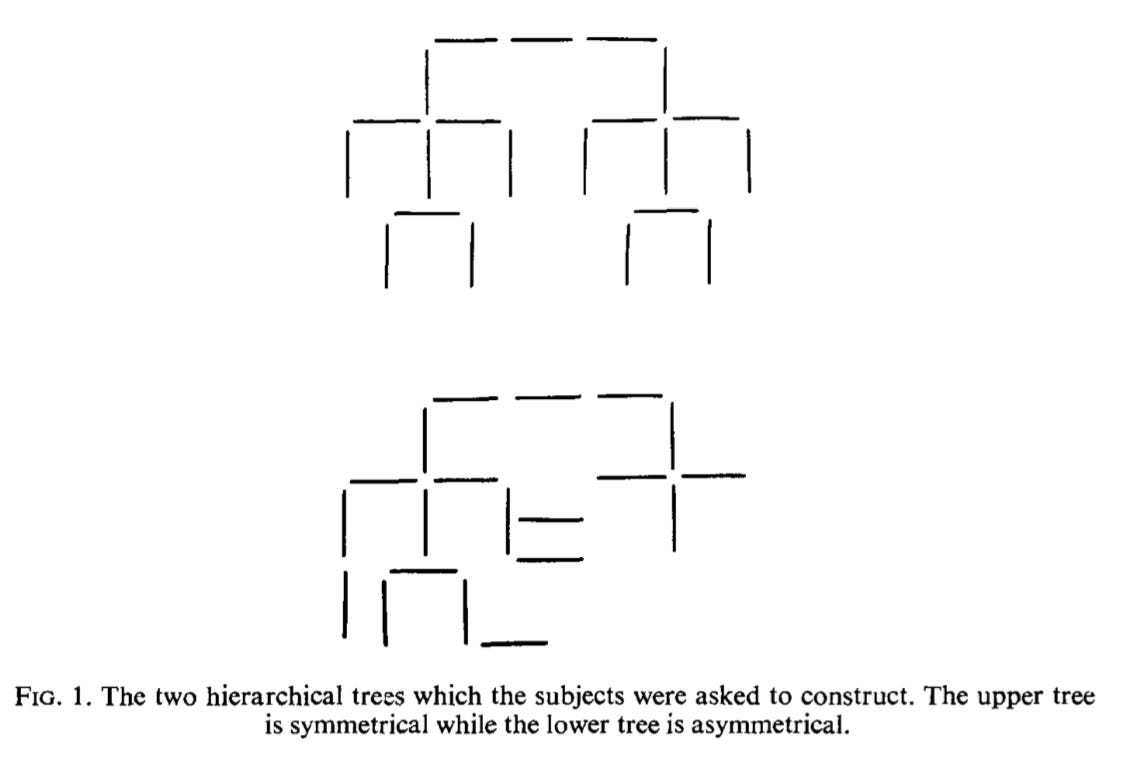
What’s special about these patterns is that they are structured as hierarchical trees — sort of like the garlic butter bacon cheeseburger phrase. Most people, when reconstructing these tongue depressor trees, start with the top middle bar, then work their way down to the lower nodes, and finally to the terminal branches. Patients with Wernicke’s aphasia (here called “fluent aphasia”, on the right) weren’t great at remembering the patterns, but they did build them hierarchically, starting with the top middle bar. People with Broca’s aphasia (left) showed no such preference — they assembled their patterns in no specific order. They did distinguish between the symmetrical and asymmetrical patterns, but failed to make either of them hierarchical, “tree-like”.
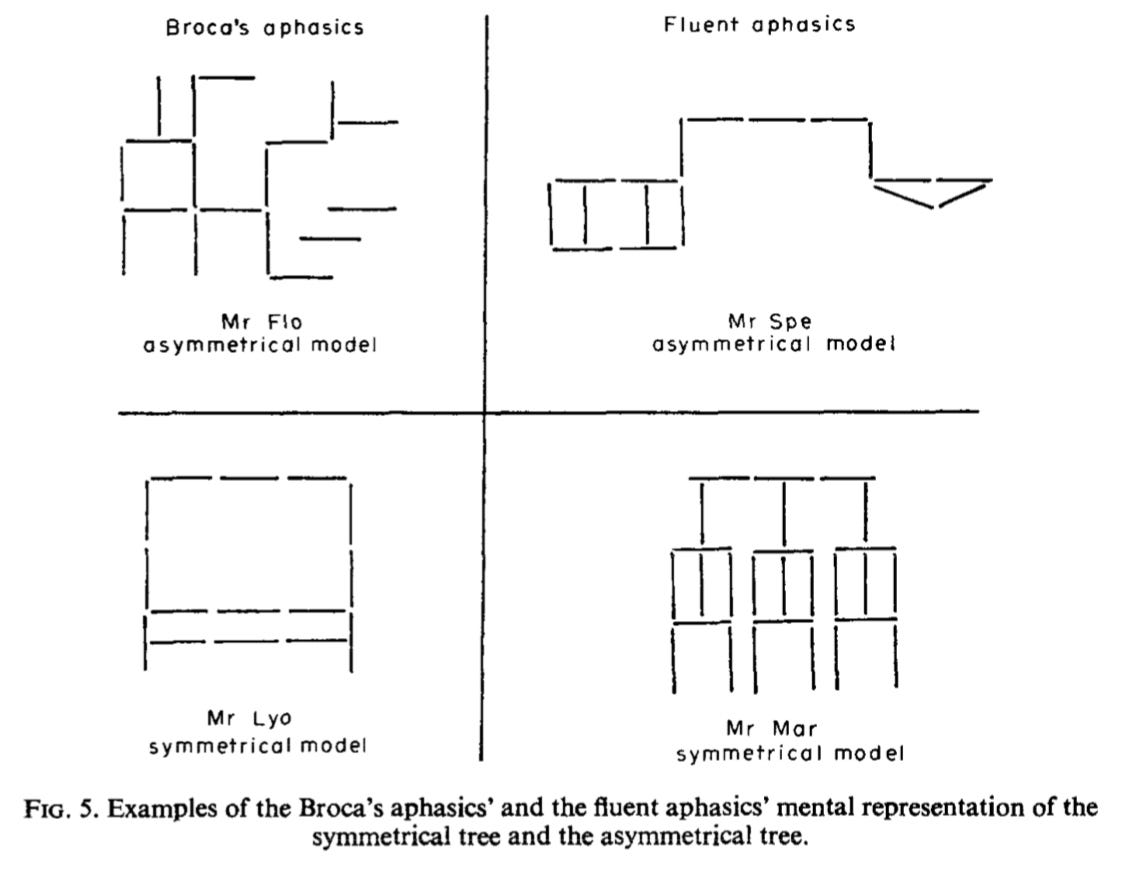
So Broca’s area is not just a language area. It’s a part of our brain that structures information into hierarchical trees. We use it to both construct such trees, and to understand them. Language just happens to be the most “tree-heavy” aspect of our cognition, and so language is the most obvious thing that’s lost when Broca’s area is damaged.
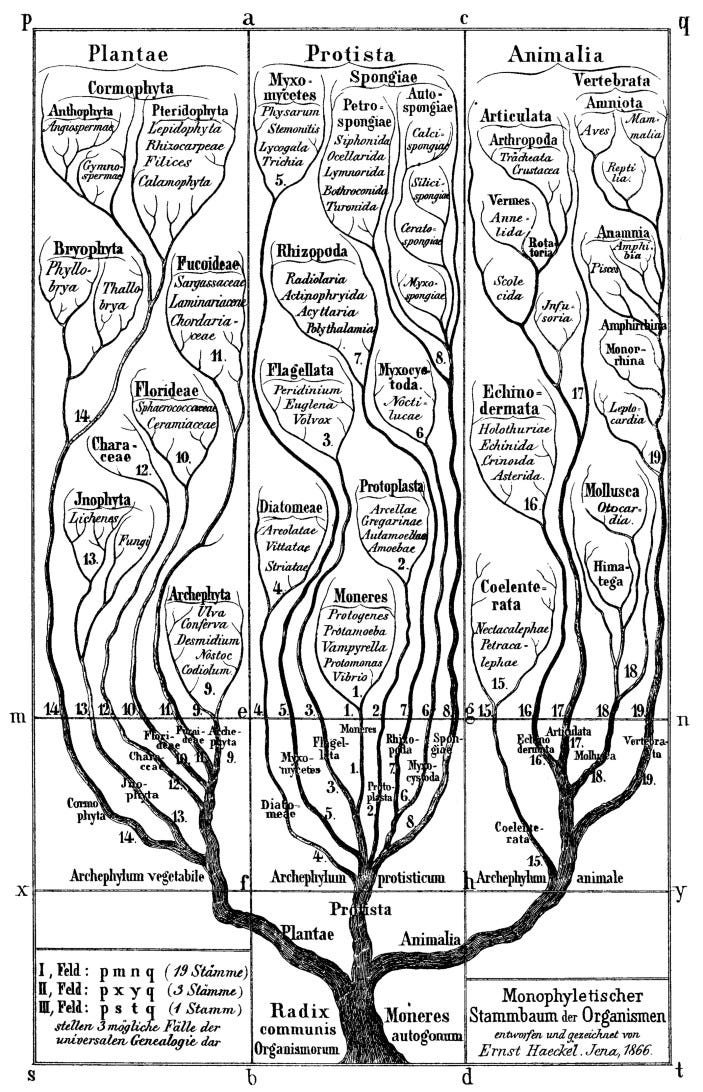
Language is what makes humans unique in the natural world. It is the precondition for culture, science, technology and art — all the things that make us distinct from all other species on the planet. Our humanness, then, boils down to these hierarchical trees. There’s something profound about the fact that they look like flipped trees of life. Nature takes one thing and makes it into many things. Our minds take many things and make them into one.